
Note
These are research findings and proposed workflows, not a release announcement. Interview examples are anonymous. Regulatory references are dated 8 October 2026.
Why mail needs a separate record
Postal items are excluded from the Warsaw and Montreal Conventions and from the IATA definition of cargo. A mail consignment moves under a UPU delivery bill (CN 38 for airmail) or its electronic twin, the CARDIT message. It cannot be "an AWB". The sanctioned bridge into a cargo system is a carrier-assigned Postal AWB number (PAWB#) with zero charges and the SHC MAL.
Posts think in despatches (post-to-post), airlines are paid per consignment (the receptacles handed over for one transport, described by one CN 38), and the warehouse handles receptacles (bags, trays, containers with a 29-character barcode). A receptacle can sit in several consignments over its journey. Belli needs separate records for each, with links between them.
What the first record needs
Start with a mail consignment record alongside the AWB. Record the postal parties and each flight movement, count mail against segment capacity, and distinguish declared from measured weight. Missing rates should stop invoicing rather than produce a guessed charge. Preserve the rates and weights used for every invoice. Add receptacle tracking, despatches, CARDIT/RESDIT and build-up to that structure.
What the interviews showed
A large UAE airline
Interviews with cargo operations and standards staff described a mail system and cargo system that do not share a record.
- In one interview, a product engineer from a large UAE airline confirmed that it uses CN38 for mail, receives CARDITs and sends RESDITs, and that posts prepare the CN38s. Its mail system is separate from cargo planning.
"Even for mail, if you block their two containers, they are delivering four containers, no visibility. It's not integrated."
A Central Asian carrier
- The booking team: "No airway bill. It's an airmail delivery bill." Stations email the CN38; the booking team registers it in its cargo system per flight; finance invoices the post from those entries; no customs filing, no tracking. Their later request to IT was simply "a mail shipment type with individual numbers".
A European airline
One European airline exports receptacle-level records for mail accounting. A rules engine resolves sectors, applies matching rates, handles EU/non-EU VAT and produces per-post invoices, with empty bags billed separately.
The route from post to post
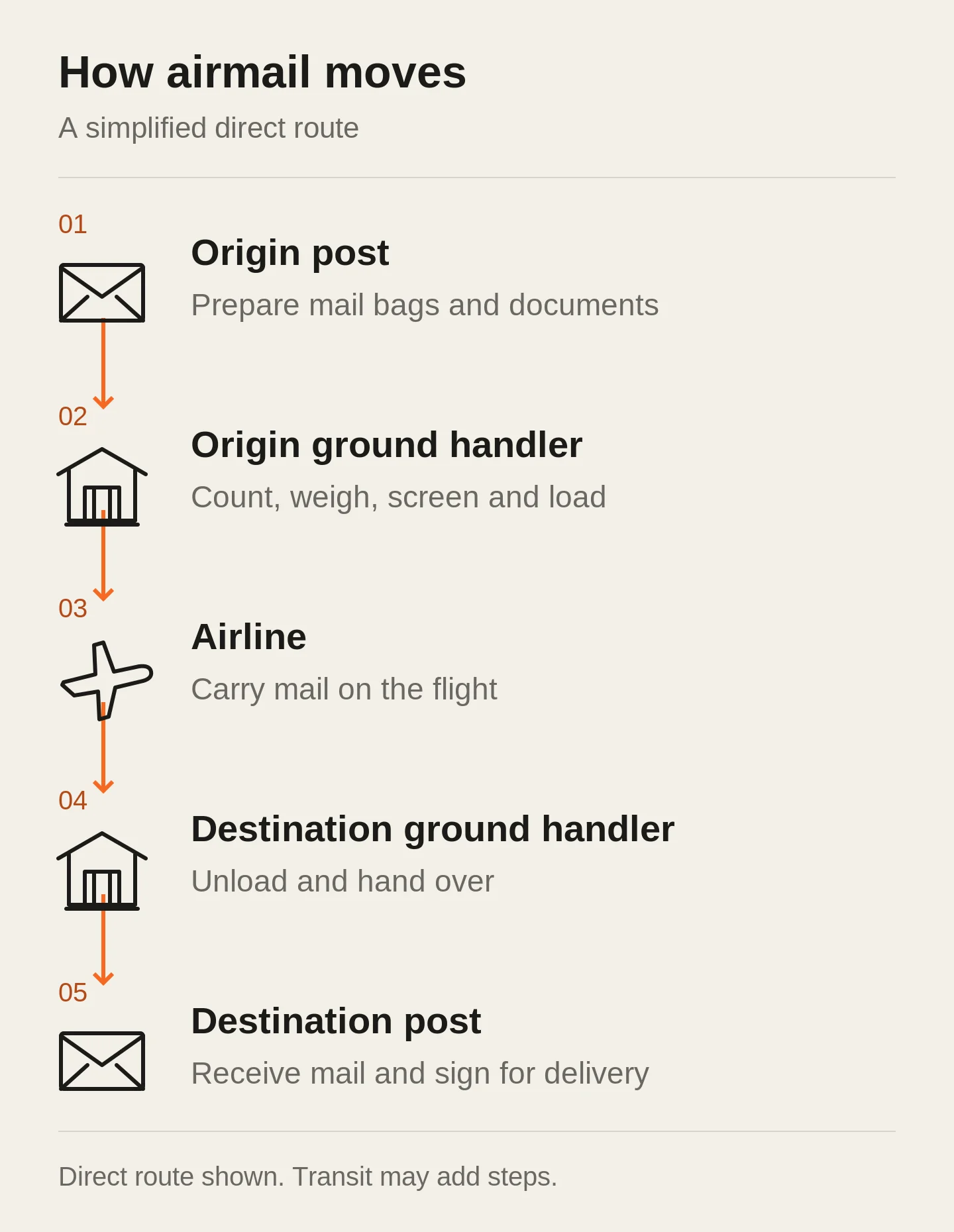
The picture shows a direct route. Transit can add another carrier or postal operator. The airline needs to know who holds the mail at each leg, which flight it is planned on, and what actually moved.
Mail codes and identifiers
Category and class are different fields. The category describes the transport service; the class describes the contents. Keep them separate in the booking record.
Mail categories
| Code | Mail category |
|---|---|
| A | Priority airmail (CN 38) |
| B | Surface airlifted mail, S.A.L. (CN 41) |
| C | Surface mail (CN 37) |
| D | Priority surface mail (CN 37) |
Mail classes
| Code | Mail class |
|---|---|
| U | Letters |
| C | Parcels |
| E | Express Mail Service (EMS) |
| T | Empty receptacles (CN 47) |
The categories follow UPU code list 115; classes and subclasses follow lists 116 and 117. EMS has separate columns and billing within the CN 38 process. LC, AO and CP are content terms, not category codes.
Records to keep
| Record | Length | Purpose |
|---|---|---|
| Consignment (S32) | Up to 12 characters | Identifies the transport covered by a CN 38. |
| Despatch (S8) | 20 characters | Identifies the post-to-post despatch. |
| Receptacle (S9) | 29 characters | Identifies an individual bag, tray or container. |
| Postal centre (IMPC) | 6 characters | Identifies an office of exchange, not necessarily an airport. |
| Postal AWB (PAWB) | Carrier-assigned | Links mail to a cargo system where an AWB-shaped record is needed. |
The consignment number is not part of the receptacle identifier. Link these records rather than using a single shipment number for every purpose.
Delivery bills and supporting forms
| Form | Purpose | Airline relevance |
|---|---|---|
| CN 38 | Delivery bill. Airmails | The document for nearly all airline mail. Prepared by the origin post's office of exchange, signed by the carrier as receipt. |
| CN 41 | Delivery bill. S.A.L. mails | Same structure, no EMS columns. Lower priority, lower rate. |
| CN 47 | Delivery bill. Mails of empty receptacles | Empty bags going home. Billed to the DO that owns the bags, capped at 30% of the basic rate. |
| CN 37 | Delivery bill. Surface mails | Trucks and ships. Relevant only for an airline's road feeder legs. |
| CN 45 / CN 46 | Transmission envelope / Substitute delivery bill | CN 45 carries the bills in the flight portfolio. CN 46 is prepared by the carrier when the bill is missing; destination must accept it. |
| CN 43 | Verification note | Post-to-post discrepancy report (missing, damaged, wrong weight) raised by the receiving office. Once accepted its values override the CN 38 in post-to-post accounting. |
| CN 35 (CN 34, CN 36) | Receptacle labels | Carry the S9 barcode. Colour coded: white priority, light blue non-priority, vermilion registered or insured, green empty bags. |
| CN 70 | Consignment security declaration | Based on the IATA/ICAO CSD. Sent inside CARDIT where possible (eCSD). |
Mail outside the CN 38
- CN 41 S.A.L. and CN 47 empty bags: still mail, different bill and rate.
- Domestic mail: outside the UPU acts; national forms and contracts (the US airline's CAIR). Needs records with no UPU identifiers.
- Military mail: closed mail on CN 38-type documents (USPS AV-7).
- Diplomatic bags: outside the postal regime; carried as cargo or by courier.
- ETOE mail and "mail as cargo": posts buying cargo capacity on an AWB. IATA's Air Mail Board calls this a non-compliant hybrid ("mail as mail, cargo as cargo"); if it is on an AWB, treat it as cargo with a mail commodity.
- Courier/express (integrators): cargo, never mail.
How mail consignments differ from AWB shipments
| Dimension | AWB shipment | Mail consignment |
|---|---|---|
| Transport document | Air waybill (Montreal Convention contract) | CN 38 delivery bill / CARDIT (UPU Convention); no AWB number unless a PAWB# is assigned |
| Customer | Agent or forwarder (CASS or direct), with credit terms | Designated postal operator (DO) under a bilateral contract; bill-to party may be a different DO or a mail GSA (Kales for La Poste at the European airline) |
| Pieces | Pieces with dimensions; volumetric and chargeable weight | Receptacles with an encoded origin weight; no dimensions; charged on gross kg per class |
| Identity | One AWB per shipment, split allowed at acceptance | Despatch → consignment → receptacle; one receptacle can be re-consigned in transit; CARDIT revisions (original, change, replace, cancellation, definitive) |
| Status messages | FSU events to agents | RESDIT events to the post (received 74, uplift 24, arrived 40, delivered 21, not loaded 57…) |
| Customs | FWB/FHL, PLACI/ICS2 filings by carrier and forwarder | Item data lives with the post (ITMATT); carrier files consignment level with PAWB and receptacle IDs where required; US inbound mail must ride an AWB for ACAS |
| Proof of delivery | DLV, signed by consignee | Destination OE signs the CN 38 copy or carrier sends RESDIT 21; discrepancies by CN 43 |
What the cargo team does
- Contract and allotment. Sales signs a postal service agreement with each DO (IATA RP 1677 is the model), with rates per sector and class and often standing capacity per flight. The CMS needs the post as a party, its IMPCs, and its allotment.
- Pre-advice. The post sends a CARDIT original before handover and updates as bags are added; or, at the Central Asian carrier, a station emails a PDF CN38. The CMS creates a planned consignment on the flight with the declared weight and receptacle count, and reserves it against segment capacity.
- Handover and acceptance. The post's mail unit delivers receptacles (bags of at most 30 kg, trays, or post-sealed containers) with the paper CN38 copies in a CN 45 envelope (the IATA framework agreement asks for at least six) plus the security declaration, before the contracted handover time. The GHA counts and weighs, scans receptacle barcodes or the container journey ID, notes discrepancies on the bill, and signs. The CMS records measured weights, sets the operational weight basis, and emits RESDIT 74 Received. Missing bill: the carrier prepares a CN 46. No CARDIT: ask the carrier whether to accept at all.
- Security and DG. Mail is screened like cargo (ICAO Annex 17); the CSD may arrive in CARDIT. Dry ice and UN 3373 must be declared on the CN38. The CMS stores the security status per consignment and station.
- Build-up. Receptacles go into ULDs or bulk. Posts may deliver their own sealed containers (container and seal numbers on the CN38). The CMS records ULD placement per movement; the US airline wants mail-only ULD statistics.
- Manifest and load control. With a PAWB, mail appears on the flight manifest as "Postal Mail" with receptacle count and weight and SHC MAL; without one it is documented by the CN 38 and a separate mail manifest (MFM), because the cargo manifest has no line type for it. Load control gets mail as a load category on the UWS and load sheet (an AHM and airline convention, not a regulatory requirement: 14 CFR 121.693 and EU CAT.POL.MAB.105 fold mail into cargo), and ULD movements go through UCM, SCM and MUC/LUC like any ULD. Mail and cargo may share a ULD; no IATA or UPU rule forbids it. Interline mail moves on transfer manifests. The CMS snapshots all of it.
- Departure. RESDIT 24 Uplift per receptacle actually loaded; RESDIT 57 Not loaded for what stayed behind, which goes to a mail lying list for replanning (the post must be told the new flight).
- Transit. Direct transhipment (same or other carrier) is written on the CN38 and carries no transit charge; a transit post re-consigns bags under its own CN38. The CMS needs movement-level custody and carrier per leg.
- Arrival and handover. RESDIT 40 Arrived, breakdown, handover to the destination OE within the contracted one to two hours, destination signs the CN38 copy, RESDIT 21 Delivered. Discrepancies go on a CN 43, which then overrides the CN38 values for accounting.
- Billing. Finance rates each receptacle or CN38 line (gross kg by class, sector, contract), issues an invoice per DO per period, handles disputes against CN38 and CN43 evidence, and books revenue. Empty bags (CN 47) and S.A.L. (CN 41) use different rates.
Who does what: airline, warehouse, post, and the two systems
| Actor | Owns | Touches the CMS for |
|---|---|---|
| Origin designated operator (post) and its mail unit at the airport | Despatch creation, receptacle labels, CN 38 preparation, CARDIT, routing choice, security declaration, item-level customs data, paying conveyance dues | Pre-advising consignments; receiving RESDITs; invoices; disputes (CN 43) |
| Airline cargo sales / commercial | Postal service agreements, rates per sector and class, standing allotments, GSA relationships for mail | Postal operator records, mail rate cards, allotments |
| Capacity control / load planning | Deciding what flies, offload order, hub flow | Seeing planned mail on every flight list and segment, with a weight basis they can trust; offload and replan |
| Booking ops (the Central Asian carrier model) | Registering station CN38s | Mail consignment entry per flight; attaching documents |
| Ground handler, origin and destination | Physical acceptance, scanning, weighing, signing bills, build-up, breakdown, handover within the contracted window | Acceptance and scan screens or mobile app; MLD/MDL feeds; discrepancy capture |
| Flight ops / load control | Load sheet, UWS, NOTOC | Mail weights per ULD and bulk; DG in mail |
| Finance / revenue accounting | Rating, invoicing posts, adjustments, revenue recognition, VAT, reconciliation with post statements | Mail charges, invoice runs, corrections, exception queues |
| Mail system (V-Mail type), if kept | CARDIT/RESDIT protocol handling, code-list validation, message delivery; sometimes billing | Feeds consignment snapshots in; receives operational facts out |
| Cargo system (iCargo, Belli) | Flights, capacity, bookings, warehouse, manifests, revenue | Must at minimum hold the mail movement to plan around it |
IATA's PAWB specification notes that "Carriers that transport mail generally have two systems: a cargo system; a mail system." The UAE airline described this arrangement in its interviews. Sharing mail movements with the cargo system would give planners access to mail bookings while the existing mail tool handles postal messages.
Messaging and connection points
Posts exchange PREDES and PRECON with each other. Airlines exchange CARDIT and RESDIT with posts. Cargo messages such as FFM, UWS and FSU carry mail as "Postal Mail" lines. If an airline keeps a separate mail tool, it must decide which system maintains receptacle membership and billing weight. The table follows UPU M48/M49 and the IATA PAWB specification.
| Message | Standard | Direction | Proposed Belli handling |
|---|---|---|---|
| CARDIT | UPU M48 v2.1 (EDIFACT) | Post → carrier | Upsert the consignment and its planned movement, versioned per message; reserve capacity; show in the flight booking list; carry the eCSD and AR flag. |
| RESDIT | UPU M49 v1.1, events from code list 100 | Carrier → post | Emit from acceptance, finalized load membership, departure, arrival and handover through an outbox with idempotency. Mapping to XFSU: 5→RCS, 14→ARR, 21→DLV, 24→DEP, 40→RCF, 42→TFD, 43→RCT, 74→FOH. |
| PRECON / RESCON, PREDES / RESDES | UPU M10/M12, M41/M13 | Post ↔ post | Not Belli's to send; useful to understand what the destination post reconciles against. |
| ITMATT, CUSITM / CUSRSP | UPU M33/M52, M43/M55, M44/M56 | Post ↔ customs | Not Belli's; the carrier never has item data. |
| FFM / XFFM, UWS, NOTOC | IATA Cargo-IMP / Cargo-XML, AHM | Carrier → handlers, customs, posts | MFM (or the CN 38 itself) is the manifest for PAWB-less mail; FFM/XFFM lines only through the PAWB# adapter. |
| XFWB / XFHL via PAWB# | IATA PAWB spec v1.0 | Carrier systems | Optional adapter so a PAWB-based downstream (customs, GHA system) can consume mail without Belli storing mail as an Order. |
| MDL / MLD, MFM | Carrier-proprietary (the US airline names them) | Handler ↔ carrier | Model as handler scan feeds that produce events; MFM as a report format. |
RESDIT events and proposed Belli triggers
| Code | Event | Proposed Belli trigger (recorded evidence only) |
|---|---|---|
| 74 | Received | Receptacle or container-journey scan at the origin GHA |
| 82 | Returned | Receptacle handed back to the post before uplift |
| 5 | Accepted | Acceptance completed as booked, no discrepancy |
| 6 / 7 | Assigned to load plan / Removed from load plan | Movement allocation confirmed or withdrawn (may repeat) |
| 48 | Loaded | Load plan closed with the receptacle in a ULD or bulk position |
| 24 | Uplift | Flight departed with the receptacle in finalized load membership (flight-level allowed) |
| 31 | En route | Wheels up (rarely used) |
| 57 / 59 | Not loaded / Off loaded | Receptacle left behind, or removed after loading |
| 14 | Transport leg completed | Flight arrived |
| 1 | Transport arrived | Wheels down |
| 40 | Mail arrived | Breakdown scan at the destination handling facility |
| 42 / 43 | Handover delivered / Handover received | Custody passed to or from another carrier |
| 23 | Mail at destination | Staged at the handover point, post not yet present |
| 21 | Delivered | Handover scan to the destination post, or signed CN 38 copy |
| 41 | Transhipment | Do not use; send 74 plus 24 instead |
- Minimum set: 74, 24, 14 and 21, preferably also 5, 23, 59 and 82 (IATA-UPU best practice, Oct 2024). USPS pays on 74, 24 and 21 (or 23 in defined cases) and requires 42 on inter-contract transfers; consignment-level RESDITs are not permitted there.
- No synthetic events. IATA-UPU describes messages as "based on positive data capturing, no automatic generated messages". Operational events need positive evidence, such as scans, rather than predicted delivery times.
How airlines are paid for mail
| Figure | What it means |
|---|---|
| 0.649 | 2026 UPU basic rate, in thousandths of an SDR per kg-km. Equivalent to 0.000649 SDR per kg-km. |
| 30% | Maximum rate for empty mail bags, as a share of the basic rate. |
| 2 months | Payment period for undisputed amounts after the airline's invoice. |
| 47% decrease | Global mail tonne-km fell from 7.2 billion in 2019 to 3.8 billion in 2024 (ICAO). |
Who pays
The origin designated operator pays the airline "air conveyance dues" for the distance flown and must settle undisputed amounts within two months of the airline's invoice. For interline routings the origin post pays the first airline (which pays the next) or each airline directly; in closed transit the transit post pays its carrier and re-invoices the origin post.
What is billed
The delivery bill (or CARDIT) is the basis for payment: consignment, origin and destination of the bill, flight, gross receptacle weight per class. The IATA/UPU framework agreement (RP 1677) lets the carrier invoice from the UPU documents, from the PAWB, or from its own substitute documents built from positive receptacle scans, and accepts a carrier's EDI scan record as proof of carriage in disputes. Diversions attributable to the airline are paid only to the airport of offloading on the CN 38; the carrier bears re-forwarding of mail it mis-offloaded; mail lost in an aircraft accident earns no dues.
Disputes and adjustments
Under RP 1677, the post may withhold only the disputed amount, must itemise it within an agreed window, and pays the rest on time; the carrier accepts or issues a supplementary invoice with proof; late payment draws interest. No UPU form exists for an airline's invoice; the Regulations only require the post to pay "the relevant invoice from the airline".
Revenue recognition
Airlines report mail inside cargo revenue and recognise it when transport is performed; a CMS should accrue per flight leg on uplift and hold unbilled revenue until the periodic invoice.
Security and customs
Mail is subject to aviation security checks. The post's contract sets acceptance, priority and handover requirements; mail does not receive automatic priority under ICAO rules.
Security
Keep the consignment's security status, issuer and evidence for each movement. The CN 70 declaration may arrive in CARDIT as an eCSD or on paper. The airline or ground handler screens mail when the post's security status is insufficient.
Customs pre-arrival data
For EU ICS2, the post files item-level F43 data and the F44 receptacle link before loading. The carrier files the master-level postal ENS F42 before arrival. Receptacle IDs link the filings, not the PAWB number.
A Do Not Load referral must be resolved before loading. The CARDIT AR flag records the origin post's EAD statement; it is not a customs clearance. Other destinations have different requirements.
Dangerous goods
International mail generally prohibits dangerous goods, with limited exceptions under postal and aviation rules. Keep dry ice and UN 3373 declarations, receptacle DG indicators and incident records with the consignment. Carry the relevant information through to load control.
Acceptance, refusal and irregularities
The carrier may refuse damaged or overweight bags, unreadable labels, late handover or mail above allocation under the applicable agreement. Record discrepancies and corrected documents. Offloaded mail needs a new movement plan and an update to the post.
If CARDIT is missing, the manual-entry path must record the carrier-generated consignment ID and its provenance. Report actual scans and handovers rather than predicted events.
Records and retention
Keep signed CN 38 copies, scans, message versions and adjustments together for disputes. UPU documents normally require at least 18 months of retention, with disputed documents kept until settlement. EU security evidence and customs records have separate retention rules. Apply the relevant contract and legal requirements.
What Belli can connect
Belli's mail-revenue tool for a European airline already applies sector rates, customer agreements, empty-bag products and EU/non-EU VAT to exported receptacle records.
The proposed next step is to connect that accounting work to mail bookings and physical movements.
- Planning. Show planned mail, allotment usage and the current weight basis on each flight. Flag overages before the bags reach the hub.
- Handling. Link bag scans, container placement, offloads and handovers to the consignment. Keep the existing mail tool responsible for postal messaging if it remains in use.
- Finance. Hold unmatched rates for review. Preserve the rate and weight used for each charge, and record corrections as adjustments rather than rewriting invoices.
- System ownership. Decide which tool updates each field. Share consignment and movement data so planners and finance do not depend on disconnected records.
Start with the booking record and its flight movements. Add detailed receptacle tracking and postal messaging where the airline needs them.
Planning before handover
The UAE airline's "we can only plan when it lands" is structural, not a V-Mail bug. A CARDIT is sent at consignment closure, "at the latest when the mail is handed over"; posts say "only some hours notice possible" while carriers want space "booked well in advance", and there is no UPU or IATA standard for mail booking or allotment messages.
- Seasonal capacity and routing plan. Under the IATA/UPU framework agreement the carrier publishes its mail routings with per-flight mail capacity limits at least a week before each IATA season (art. 9), and the post returns a routing plan and volume estimates by route, flight and weekday (art. 15), with agreed over- and under-tender tolerances. USPS goes further: lane forecasts 70 days ahead, carrier-submitted routes with offered capacity, an 80% weekly commitment floor, nominations answered within 72 hours, and take-or-pay minimums (the USPS inspector general found USD 25.7m a year paid for unused domestic capacity).
- Booking updates from early CARDITs. The function codes allow an Original (9) before first handover with expected volumes, Changes (4) or Replacements (5) as bags are added, and a Definitive (47) at closure; the IATA-UPU minimum is "at least a 47", and Correios asks its airmail units to generate the CARDIT at least 4 to 6 hours before the carrier's RESDIT 74. How many posts send early Originals is not published, so the CMS must treat every CARDIT version as an update to the planned movement and show forecast versus CARDIT versus actual per flight.
- Scan-based events with nesting. Scan the container journey ID once at handover, report RESDIT 74 for every receptacle inside; the same at uplift (24), arrival (14, 40) and delivery (21). The events require recorded operational evidence, such as scans.
Inbound CARDIT defects a CMS should catch
- Late or missing CARDIT; receptacles repeated across active CARDITs; receptacles never updated; obsolete flight numbers; missing segments; totals that do not match the receptacle list; duplicate receptacle IDs; consignment ID not matching the origin country; main-flight departure before consignment completion; invalid receptacle type; weights with commas; consecutive flights under 90 minutes apart; missing AR flag for EU destinations.
- RESDIT side: duplicates, events without CARDIT, passive links. The UPU's monthly dashboard scores exactly these, so the CMS should compute them first.
Sources
- UPU Convention Regulations (POC Regulations 2024 consolidation) and UPU Convention Manual (2025/2026 editions): Regulations, Manual.
- UPU Postal Transport Guide (Jan 2024): link.
- UPU S9 receptacle identifier: link; Catalogue of UPU Standards 2026: link; mail subclasses and handling classes: link.
- UPU CARDIT compliance explanatory notes v1.7 (2026): link.
- IATA Postal Air Waybill (PAWB) functional specifications v1.0: link; IATA air mail programme: link.
- CHAMP Cargospot AirMail newsletter: link.
- European Commission, air cargo and mail security (ACC3, RA3, KC3): link.
- UPU/IATA/IPC EDI Guide (2017): link; IATA RP 1677 Framework Postal Service Agreement: link; IATA Air Mail Board, "Non-Compliant & Hybrid Scenarios in Air Mail Operations" (2026): link.
- UPU messaging standards version history (Feb 2026): link; UPU RESDIT compliance notes: link; UPU eCSD guidelines with an annotated CARDIT interchange: link; UPU airline compliance project overview: link; UPU EAD country requirements (May 2026): link; UPU paper-free roadmap: link; UPU BACR 2026 circular: link; UPU EAD Transport: link.
- IATA-UPU joint webinars: 7th (Oct 2024), Oct 2023 (the US airline, a European carrier), Nov 2022 (the Asian carrier, IPC MRD), May 2023 (EC on ICS2 F42); IATA EU-ICS2 mail position paper: link; IATA-UPU Mail Safety Guidelines: link; IATA PASS: link.
- Market: ICAO Annual Report 2024 tables: link; UPU State of the Postal Sector 2024: link; UPU on the US de minimis suspension: link.